 Lidofinance
Lidofinance withdrawals require queue finalization before ETH can be claimed
Lidofinance withdrawals redeem stETH or wstETH through a queue that must finalize each request before its owner can claim ETH. A successful request commits the selected tokens to redemption and creates an unstETH NFT representing the claim. Finalization reserves ETH; a later claim transaction sends it to the recipient. Available ETH, earlier requests, and protocol accounting govern the wait, so an estimated completion time is not a deadline. Queued tokens stop adding staking rewards, and protocol losses can reduce the eventual payout. Selling stETH or wstETH through a market swap avoids this queue, with proceeds determined by execution prices and costs.
Key takeaway: An unstETH NFT preserves the withdrawal claim, while finalization determines the reserved ETH its current owner can collect.
Request size has a fixed cap while waiting time changes
Each request must contain at least 100 wei of stETH and no more than 1,000 stETH, measured after any wstETH conversion. The transaction reverts if any individual request falls outside these bounds. Larger redemptions need multiple requests, which the contract supports submitting together. Each receives its own queue position and NFT. The cap limits request size; available ETH and queued demand govern fulfillment.
The queue finalizes each request in full, so separate requests can reach claimable status at different times. Their creation order preserves priority behind earlier requests. The protocol also needs enough ETH to fund eligible requests.
Queued redemption and market swaps release ETH differently
The relevant timing difference is whether ETH comes from a successful claim after protocol finalization or a completed trade against market liquidity. Both stETH and wstETH support these exit choices. Their token formats affect conversion and approval, while the chosen mechanism determines when the ETH becomes available.
| Token and exit method | Condition for receiving ETH |
|---|---|
| stETH protocol redemption | The request must finalize before the owner can claim reserved ETH. |
| wstETH protocol redemption | Internal unwrapping precedes queue entry; finalization and claiming still apply. |
| stETH market swap | A trade must settle against available liquidity; no protocol withdrawal queue applies. |
| wstETH market swap | A route accepting wstETH must settle the trade into ETH; no protocol queue applies. |
| Protocol redemption depends on queue fulfillment; market exits depend on trade execution. | |
A swap quote specifies a proposed exchange outcome. Market prices, trade size, liquidity, and execution costs affect the ETH received. Protocol redemption instead uses the request’s recorded amount and the applicable finalization share rate. Comparing the same input token amount shows how the routes differ in ETH proceeds. A faster route can produce a different payout, and a favorable quote cannot guarantee successful settlement.
Token ownership and network access come before a request
The requesting account needs a spendable stETH or wstETH balance on Ethereum mainnet and permission for the withdrawal contract to transfer the selected tokens.
Balances held in another contract
Tokens deposited into a lending application or liquidity pool belong to that application’s position until its withdrawal rules release them. A deposit receipt represents a position in the application; queue redemption requires the underlying stETH or wstETH to be spendable. Collateral restrictions or outstanding borrowing can affect access to the underlying tokens.
Bridged tokens and Ethereum mainnet
Tokens held on another network require a compatible transfer to Ethereum mainnet before entering its withdrawal queue. Returning tokens through a supported bridge introduces the bridge’s own timing, costs, and completion conditions. Local market swaps may offer another exit where suitable liquidity exists. Bridge settlement and Lido queue finalization are separate dependencies, so their waiting periods must not be treated as one fixed duration.
Authorization and queue entry record different commitments
Approval authorizes token spending, while an accepted withdrawal request commits the selected amount to the queue and records the account owning its unstETH NFT.
Allowance or a signed permit
An existing token allowance can authorize the withdrawal contract to move the requested balance. The protocol also supports ERC-2612 permit methods, which use a signed authorization within the request call. A signed permit can supply authorization without an upfront approval transaction. Interface and wallet support determine which method is available. The spending permission must cover the correct token and withdrawal contract, whether an allowance or permit supplies it.
Token commitment and the request record
The wstETH request method transfers and unwraps wstETH before placing the resulting stETH into the queue. Its NFT represents the right to claim ETH after that request finalizes. A signed authorization or submitted transaction hash alone does not establish queue entry. A successful request creates an on-chain record linking the amount, owner, and identifier. Once accepted into the protocol queue, the withdrawal cannot be canceled.
When does a withdrawal become claimable?
A withdrawal becomes claimable after the protocol finalizes its request, provided the request has not already been claimed. Enough ETH must be available, and the request must satisfy the applicable timing and accounting constraints. Finalization reserves ETH for the request in the withdrawal contract. It also fixes the redemption value and burns the associated stETH. ETH remains reserved until the owner claims it; finalization does not send it automatically.
The request status exposes separate finalized and claimed fields. A finalized, unclaimed request is ready for collection, while a pending request still needs protocol processing. Claimable-amount queries return zero for requests awaiting finalization and requests already claimed, so an amount alone cannot distinguish those states. The claimable amount belongs to the identified request, not every withdrawal associated with the account.
Queued tokens stop adding rewards and retain loss exposure
The redemption ceiling follows the stETH amount recorded at queue entry, including the stETH obtained by unwrapping a wstETH request. Tokens committed to the withdrawal queue do not earn additional staking rewards for the requester. Rewards already reflected in the submitted position form part of that starting amount.
Normal redemption corresponds to the submitted stETH amount in ETH, subject to small accounting-rounding differences. Significant staking losses can instead reduce the amount fixed at finalization. Slashing and penalties affect pending requests through the protocol’s share-rate accounting. The market discount or premium a swap may offer follows separate pricing. Once finalization fixes the claim, later staking updates do not increase its reserved ETH.
What does claiming change in the wallet?
Claiming transfers the ETH reserved for a finalized request to its recipient and burns the corresponding unstETH NFT. An unclaimed request still represents a right to collect ETH.
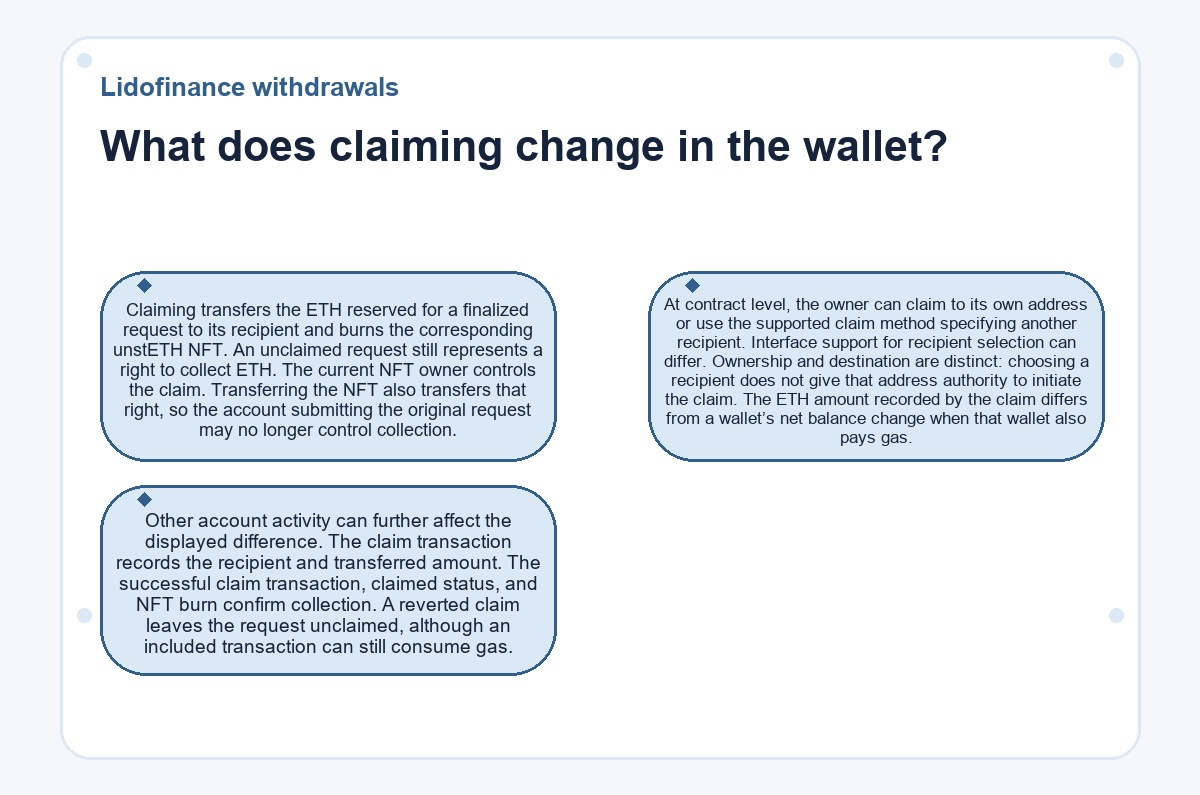
The current NFT owner controls the claim. Transferring the NFT also transfers that right, so the account submitting the original request may no longer control collection. At contract level, the owner can claim to its own address or use the supported claim method specifying another recipient. Interface support for recipient selection can differ. Ownership and destination are distinct: choosing a recipient does not give that address authority to initiate the claim.
The ETH amount recorded by the claim differs from a wallet’s net balance change when that wallet also pays gas. Other account activity can further affect the displayed difference. The claim transaction records the recipient and transferred amount.
The successful claim transaction, claimed status, and NFT burn confirm collection. A reverted claim leaves the request unclaimed, although an included transaction can still consume gas.
Network fees follow execution and gas demand
Lido does not charge a protocol withdrawal fee for this queue redemption, while Ethereum charges gas for the transactions executing the request and claim.
A separate approval, when needed, adds another transaction. The number of transactions depends on existing approvals and the method the interface supports. Gas cost depends on the computation executed and the effective fee per gas at inclusion. Batching requests changes the work performed, so it does not promise a fixed total charge. For an ordinary wallet paying its own fees, ETH must already be available to submit the transactions. ETH reserved in an unclaimed request cannot pay that wallet’s upfront gas requirement. A market exit has its own trading and execution costs, which belong in the comparison with queued redemption.
Why can a pending withdrawal take longer?
A pending withdrawal can take longer when earlier requests consume available ETH, accounting cannot finalize it yet, or adverse validator conditions impose additional processing constraints.
The protocol can obtain withdrawal liquidity from its deposit buffer, validator withdrawals, and execution rewards. Available funds can reduce reliance on validator exits. When exits are necessary, Ethereum’s exit and withdrawal processing adds its own constraints. The amount entering the queue and incoming ETH can change after an estimate appears.
Turbo mode uses the normal finalization rules. Bunker mode adds constraints for accounting for significant staking losses before eligible requests finalize. These rules delay requests the protocol cannot yet safely finalize. Separately, a pause of the core withdrawal queue blocks new requests and finalization while permitting claims already finalized. These conditions affect different request states. Increasing a transaction’s gas bid can influence its inclusion; it cannot fund the queue or override the protocol’s finalization rules.
A queued claim has different liquidity from stETH
After queue entry, the selected tokens are no longer available in the holder’s wallet for a market swap. The transferable unstETH NFT represents the remaining claim, with its own ownership and finalization status. Selling it transfers that claim to a buyer and does not reverse the withdrawal. Any sale requires a buyer and agreed terms; transferability does not promise an immediate sale or a payout equal to the reserved ETH.
Tokens left outside the queue remain separate from the submitted withdrawal. They can support a different exit choice where available balances and market liquidity permit it. For the queued amount, access to ETH remains limited by finalization and collection of its claim.
Answers to common questions
Will stETH bought through an exchange qualify for protocol withdrawal?
stETH acquired through an exchange can enter the withdrawal queue when the requesting account holds the authentic token on Ethereum mainnet. The contract checks the available balance, authorization, and request amount. Eligibility does not require the account to have made the original staking deposit. A balance still held by an exchange must first become accessible.
Does approving an unstETH NFT let another account claim ETH directly?
An NFT transfer approval does not directly authorize another account to claim through the core withdrawal contract. Its claim methods require the caller to own the request. An approved account may transfer the NFT, however, and ownership after that transfer carries the claim right.
Why does my withdrawal NFT still look pending after finalization?
A wallet can show outdated NFT artwork even after the underlying request has finalized. The contract updates withdrawal metadata, but wallet software may not refresh its display automatically. The request’s finalized and claimed fields determine whether collection remains available. An unchanged image does not establish a delay in protocol processing.
Can several finalized withdrawal requests be claimed in one transaction?
The core withdrawal contract supports claiming several finalized, unclaimed requests in one transaction when the caller owns all of them. The batch must contain valid request data, including the required checkpoint hints. An invalid item can make the whole call revert. Wallet and interface support determine whether that batching option is exposed.
What happens if the ETH recipient contract rejects a claim payment?
The claim transaction reverts if the recipient contract rejects the ETH transfer. That reversal preserves the unclaimed request instead of completing collection without payment. The included transaction can still incur gas costs. The NFT owner can use a supported recipient-selection method for a compatible destination, subject to the interface exposing that method.