 Lidofinance
Lidofinance staking choices between Lido Core and stVaults
Lidofinance offers pooled Ethereum staking through Lido Core and operator-specific staking through stVaults. Lido Core issues stETH automatically against an ETH deposit and allocates stake through staking modules. An stVault lets its owner select the node operator and decide whether to mint stETH against collateral. The choice turns on control, usable liquidity, and ongoing obligations. Dedicated staking performance accrues to the vault, while minted stETH creates a liability the vault must cover.
The short version: Minting stETH gives an stVault transferable liquidity while creating a growing liability backed by its dedicated staking position.
Core allocation and dedicated operator control
If choosing a particular operator matters to the staking arrangement, stVaults provide that control; Lido Core distributes pooled stake through its modules. Core depositors hold a pooled position represented by stETH. They do not assign their deposit to an operator of their own choosing. A vault owner establishes a dedicated arrangement, including operator fees and validator configuration, within the protocol’s constraints.
stVaults operate alongside Lido Core on Ethereum mainnet. They extend the available staking arrangements without replacing the pooled deposit path.
Owning a vault also differs from depositing into a product built on one. A DeFi Wrapper can pool deposits and add strategy contracts around an stVault. In that configuration, product contracts determine participation and redemption terms. A deposit into such a product does not automatically grant its depositor the underlying vault’s owner permissions.
Minting with current vault accounting
In this hypothetical example, a successful mint requires an authorized owner, a connected stVault, sufficient collateral, and available capacity. Assume the vault is healthy, its applied oracle report is fresh, and its limits permit the selected amount. The owner requests stETH for a chosen recipient.
Successful execution sends stETH to that recipient and increases the vault’s recorded liability. The backing ETH remains within the vault position. Minting creates transferable liquidity without requiring a validator exit.
The expected changes are a token receipt and a corresponding liability increase. Compare them with the successful transaction’s events and the token and vault contract records. A submitted transaction identifier alone does not establish those changes.
For the edge case, assume the same direct mint call encounters an outdated report. The call reverts, so the expected token receipt does not occur. Applying an available fresh report addresses this prerequisite; the remaining collateral and capacity rules still apply. The stVaults Web UI can prepend the update within the same transaction batch.
Collateral reserves and usable minting capacity
A vault’s ETH value supports stETH minting only after reserve requirements, fee obligations, and applicable caps leave enough capacity. Its reserve ratio preserves a buffer against losses. A lower required reserve can permit more liquidity from the same backing, while a larger reserve leaves more value behind the outstanding liability. The owner cannot simply select a lower ratio; the vault’s applied risk terms govern it.
The 1 ETH connection deposit cannot serve as backing for minted stETH. This connection requirement differs from ETH needed to activate validators. Additional slashing reserves can also restrict usable collateral when the relevant conditions apply.
OperatorGrid applies limits at vault, tier, and operator-group levels. Aggregate stVaults capacity and Lido Core staking rate limits can further constrain issuance. These limits make remaining capacity more informative than total ETH supplied. Existing minted liability also consumes capacity, and outstanding fees reduce the value available for calculation. Applied parameters and on-chain capacity describe the position more accurately than an advertised reserve percentage alone.
Does leaving stETH unminted remove every vault fee?
A connected stVault can accrue infrastructure or reservation fees without minting stETH because those charges use different bases. Infrastructure, reservation, and liquidity fees use Lido Core’s gross annualized staking return as a benchmark. Infrastructure fees apply to total vault value. Reservation fees use minting capacity; liquidity fees use outstanding stETH liability. Applied on-chain tier and vault-specific rates determine each charge, including whether a component has a zero rate. The node operator’s separate fee applies to vault growth under its agreed terms. Core instead charges its protocol fee on staking rewards. Ethereum transaction gas adds execution costs independently.
Validator performance and growing stETH obligations
Once a vault mints stETH, its economic outcome depends on both its own net staking rewards and growth in its outstanding liability. The operator’s validation performance affects the vault’s reward stream. Protocol and operator fees reduce those rewards before they contribute to the owner’s outcome. Core’s pooled reward accounting does not substitute for measuring that dedicated position.
An stVault’s stETH liability grows with the stETH share rate. The minted token belongs to the common stETH supply and follows its accounting. Choosing an operator with different performance does not give that token a separate vault-specific reward rate. The vault must continue backing its recorded liability as the share rate changes.
Keeping minted stETH preserves an asset whose rebase follows that liability growth. Selling or transferring it leaves the liability with the vault.
The reported vault bottom line subtracts liability growth from net staking rewards. This distinction matters when comparing an operator’s headline staking performance with holding pooled stETH. Additional income or losses from using the minted token in DeFi sit outside that basic vault calculation. Also distinguish supplied ETH from active stake: ETH waiting on the vault contract does not earn validator rewards merely because it contributes to the vault’s total value.
Operator concentration and shared protocol dependencies
A dedicated vault concentrates its validation exposure around its selected operator, while reserve requirements and shared contracts limit how that exposure interacts with stETH. The node operator address is fixed when the vault initializes. Its validator keys perform staking duties, and withdrawal credentials point to the vault contract. Selecting the correct operator address therefore belongs before funding, alongside checking owner and manager permissions.
Vault reserves absorb losses before they become uncovered liabilities. Severe losses can exceed that buffer. The bad-debt framework can shift uncovered liability to other vaults of the same operator, subject to limits. Its escalation path can ultimately absorb remaining losses at protocol level through a reduced stETH rebase. Separate vaults therefore provide segregation without eliminating every shared economic dependency.
A reserve falling below the forced rebalance threshold permits forced rebalancing and restricts minting, withdrawals, and new validator deposits. Owners can add ETH or repay stETH to improve collateralization. Those controls remain subject to contract rules; dedicated operator selection does not confer unrestricted access to collateral.
Token liquidity, underlying ETH, and disconnection
Choosing stETH liquidity leaves a different exit obligation from recovering an stVault’s underlying ETH, because minted liability remains attached to the vault. A token holder can seek ETH through the protocol withdrawal queue or a market swap. Queue completion depends on available ETH and withdrawal processing; a swap uses the executable market rate. Neither route automatically clears the minting vault’s recorded debt. The owner can repay stETH or use authorized rebalancing with a fresh report to transfer available vault ETH into Lido Core. Rebalancing reduces vault value and liability together at 1:1; the minted tokens remain in circulation.
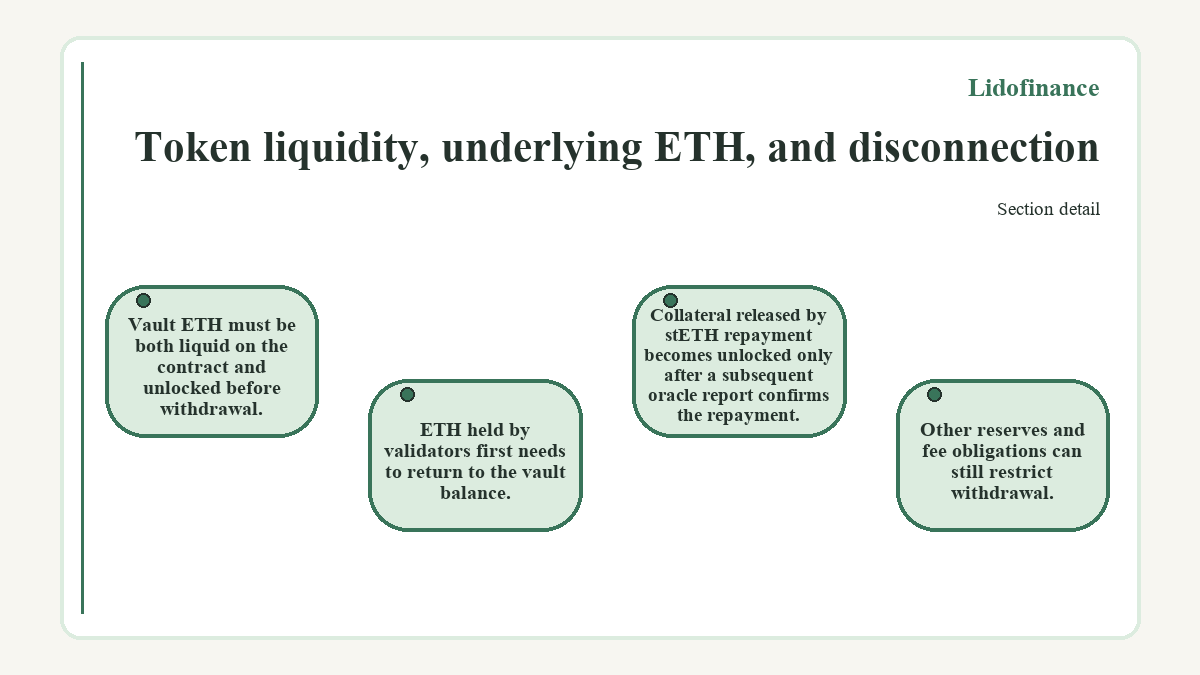
Vault ETH must be both liquid on the contract and unlocked before withdrawal. ETH held by validators first needs to return to the vault balance. Collateral released by stETH repayment becomes unlocked only after a subsequent oracle report confirms the repayment. Other reserves and fee obligations can still restrict withdrawal.
Disconnection requires cleared liability, fresh accounting, and sufficient balance to settle fees. While disconnection is pending, minting and ETH withdrawals are blocked. Applying a report dated after initiation completes disconnection only if no slashing obligations or liability remain. Otherwise, disconnection aborts and the vault returns to its connected state. Successful disconnection stops Lido fee accrual. Validators can continue operating, while the vault loses access to newly minted stETH.
Lidofinance: frequently asked questions
-
How can an stVault mint wstETH directly?
- A Basic stVault can mint wstETH through its Dashboard, which wraps the minted stETH automatically. The owner can choose the receiving address without manually wrapping the token afterward. This output format does not change the underlying collateral requirement or the vault’s share-based liability. The requested amount still has to fit its available minting capacity.
-
Does minting have to wait for the vault’s validators to activate?
- An stVault can mint against qualifying supplied ETH before its validators activate. Available capacity, fresh accounting, and the vault’s permissions govern the mint. Receiving stETH therefore does not prove the backing ETH already earns validator rewards. Minting locks collateral. If a later validator deposit uses that collateral, the operator’s method must support spending locked ETH.
-
Who can change the node operator fee after a vault connects?
- Changing a Basic stVault’s node operator fee through Dashboard requires confirmation from both the Vault Owner and the Node Operator Manager. Both must approve the same call within the configured confirmation window. Either side can propose it. Approval of the operator fee does not set Lido’s separate protocol fees, which follow the applicable protocol parameters.
-
Can existing validator funds enter an stVault through consolidation?
- Eligible validator funds can move through Ethereum consolidation into an active validator whose withdrawal credentials point to the stVault. Source credentials, validator status, activation age, and pending withdrawals determine eligibility. Consolidation transfers effective balance; excess rewards follow the source validator’s withdrawal credentials. The operation is irreversible. The documented stVaults CLI route requires a fresh vault report and NODE_OPERATOR_FEE_EXEMPT_ROLE for the source validator’s withdrawal address.
-
Why can reported vault growth remain unavailable for minting?
- LazyOracle can quarantine a reported value increase it cannot reconcile with accounted vault flows. Quarantined value does not increase recognized collateral, minting capacity, or vault health. Dashboard’s operator fee calculation can still include that growth. If the increase remains above the permitted growth threshold, release requires applying a later report whose timestamp meets the configured quarantine period. A report back within that threshold can clear quarantine earlier. Elapsed time alone does not release it. Ordinary funding through fund() records incoming ETH directly in vault accounting.